
Talk to us

Specialised Investments Simplified

By
Lucy Wylde

Investments

Empowering Financial Advisers with Clear Insights and Tailored Investment Strategies

Hello and welcome to the August edition of We Complement’s Specialised Investments Simplified newsletter, thoughtfully written by our very own Lucy Wylde.

At We Complement, we understand the important role you play in guiding your clients through often complex investments. We’re here to make that journey a little easier for you, offering clear, practical insights that you can share with confidence. Whether it’s helping your clients navigate inheritance tax, uncovering opportunities in AIM portfolios, or exploring the exciting potential of Venture Capital Trusts, our goal is to arm you with the knowledge and tools to better serve your clients and support them in reaching their financial goals.


Continuing the trend for the 2024/25 tax year, Inheritance Tax (IHT) continues to raise a significant level of revenue for the government. Data published by HM Revenue and Customs (HMRC) on the 19th of July 2024 show that between April and June of this tax year, inheritance tax receipts hit £2.1 billion. This figure is £83 million higher than the same period last tax year.

Although omitted from Labour’s manifesto, it does feel like Inheritance Tax would be an obvious target for the new Chancellor to raise the £22 billion required to cover unfunded pledges inherited from the previous government.

However, while there have long been calls for reform to the system, it now seems increasingly unlikely that any major overhaul will happen. Of the changes that may be made, it appears unlikely that they will benefit ‘the many.’

In particular, there have been reports that the new government may abolish the current reliefs for farms and businesses, which enable either 100% or 50% of certain businesses and business assets to qualify for IHT exemptions under Business Relief. This would also impact investors with qualifying AIM-listed shares, which, after two years of ownership, also qualify for 100% IHT exemption.

Of course, this is all speculation at present, as the new government’s actual plans will not be revealed in full until Labour’s first Budget on Wednesday, the 30th of October.

With the above in mind, we have taken a look back at the Q2 2024 performance of the Rathbones I W & I AIM Portfolio IHT Plan and look forward to the launch of the Foresight Technology Venture Capital Trust (VCT) PLC.

Rathbones I W & I AIM Portfolio IHT Plan

Having recently become part of the Rathbones Group Plc, Investec Wealth & Investment (UK) now manages over £1 billion in assets, including those under Rathbones.

Individually, as of the end of June 2024, Investec Wealth & Investment (UK) managed just under £750 million of assets for clients purely in AIM IHT accounts.

According to the Q2 2024 performance update published on the 1st of August 2024, the Rathbones I W & I AIM Portfolio IHT Plan net 12-month return (on a rolling quarter-by-quarter basis) is 5.1% over the last 10 years.

In terms of the estimated revenue split for the portfolio, as of the 30th of June 2024, the UK has a 44% revenue exposure. This was reduced from approximately 50% as more global companies were introduced into the portfolio. While revenue in the UK has decreased, there are 10 companies within the Rathbones I W & I AIM Portfolio IHT Plan where over 80% of revenues are derived domestically.

From a market capitalization point of view, nearly 50% of the companies in the portfolio have a market cap above £500 million, with the average weighted market cap at £516 million. This aligns with Investec Wealth & Investment (UK)’s investment philosophy of quality, where many companies that meet their investment criteria are well-established and have grown into sizable companies.

The dividend yield at the end of the second quarter of 2024 was 1.7%.

Turning to performance, it was another strong quarter. Quarter 2 of 2024 closed with the cumulative performance of the portfolio up by 4.6%, compared to both the FTSE AIM All-Share Index at 3.5% and the FTSE All-Share Index at 3.7%. This continues the trend of the Rathbones I W & I AIM Portfolio IHT Plan outperforming the FTSE AIM All-Share Index over the past 1, 3, 5, and 10-year periods.

In connection with the above, the top three contributing companies during Q2 2024 were Keywords Studios PLC, followed by Alpha Financial Markets Consulting PLC and Lok’nStore Group PLC.

The panel and market research business, YouGov, was the worst performer, costing the portfolio 0.230 basis points (bps) of performance in the second quarter of 2024, due to an overweight asset allocation compared to the index.

Foresight Technology VCT PLC

Over the past three years, total fundraising into Venture Capital Trusts has exceeded £3 billion.

Managed by Foresight Group LLP, the Foresight Technology VCT PLC is the only VCT with a focus on deep technology.

Deep technology refers specifically to companies that solve significant, high-value problems through scientific or engineering breakthroughs. This is a sector that has consistently delivered strong returns, with these types of companies making up 25% of all so-called unicorn exits (startup companies with values exceeding $1 billion USD) within the last year.

Foresight Technology VCT PLC consists of one share class, the FWT Share class, which intends to invest principally in early-stage UK technology companies.

After originally raising £37.8 million through an Ordinary Share issue in 2010/2011 and 2011/2012, the Foresight Technology VCT PLC subsequently issued the “C” shares fund of £13.1 million and a “D” shares fund of £5.6 million. However, on the 29th of June 2018, the C and D shares funds were merged with the Ordinary Shares fund, which was then merged with the FWT Share class just over five years later.

As of the 31st of March 2024, the number of FWT Shares in issue was 32,445,165, with investments made into 30 companies totaling £20.2 million. The Net Asset Value (NAV) per share at this time was 98.8p.

So far, the strategy’s first two exits, Codeplay and Flusso, have generated returns of 16 times and 3 times the capital invested, respectively.

The Foresight Technology VCT PLC, which is currently closed to new investors, aims to target UK unquoted companies that it believes will achieve the objective of producing attractive returns for shareholders.

A further launch is planned for mid-September of this year.


As you close out this month’s newsletter, we hope you’re walking away with fresh insights. At We Complement, we’re more than just a resource—we’re your partner in helping your clients achieve their goals. We know that every client is unique, and we’re here to help you tailor investment strategies that not only meet their needs but also reflect their aspirations. Whether your clients are looking to optimise their tax planning, diversify their investments, or explore new financial opportunities, we’re right here with you, ready to support your efforts. If you’re looking for more personalised guidance or have any questions, don’t hesitate to get in touch with us. Let’s work together to simplify the complexities of specialised investments and make a real difference in your clients’ financial lives.

 

Sustainable Investing

As we are all aware, there now is a greater focus on ESG investing. Many clients can have very strong views on the particular types of investments that they want to invest in or avoid. This can be something that resonates with the client on a personal level, or maybe they just feel that they can make a small difference with their investments.

Because of the increased criteria that is placed upon investments to qualify as ESG, there are generally fewer underlying investments available to choose from.

Following new research at Morningstar, investors in Asia and Europe can invest in ESG without it affecting their risk exposure. Ronald van Genderen, CFA (Senior Manager Research Analyst) states the following: “This is because sustainable funds, whether active or passive, generally differ very little in size and style exposures to their conventional counterparts, thus providing a reassuring option for investors seeking to invest sustainably,”

Source: Switch to sustainable investing has minimal impact on risk exposure, says Morningstar

This is good news for ESG investors, as they can be safe in the knowledge that their portfolios can retain their diversification and not be weighted too far in one particular sector or region.

Investing in the ‘Magnificent Seven’

The Magnificent Seven is a group of stocks from high performing and influential companies in the US Stock Market. These companies are Alphabet, Amazon, Apple, Meta, Microsoft, Nvidia & Tesla.

Over the past five years, these companies have demonstrated impressive performance, especially NVIDIA, which has achieved a remarkable return of approximately 3,000%. Each of these companies is deeply invested in technology and AI, positioning them at the forefront of their respective fields.

In addition to this, they are all companies with a strong brand recognition, which means that their customers are extremely loyal. This will likely lead to further growth in the future, a constant income stream and continued focus on technology.

These seven firms have dominated markets over the last few years.  For example, 30% of the returns within the S&P 500 over the last year have come from Nvidia alone. While this performance is impressive, it does lead to questions about the future performance of these indices.

In their latest market update, IBOSS Asset Management state the following:

“This heavy reliance on one company’s performance should raise concerns about the of market gains driven by a narrow segment of stocks. The critical question is how long Nvidia can continue to drive the stock market higher or when it will trigger a downturn. The answer lies in the company’s future performance and market dynamics. While the AI sector’s growth potential remains robust, any adverse earnings reports or unforeseen challenges could significantly impact Nvidia’s stock price and, by extension, the broader market.”

Source: The Magnificent Risk?

US Politics

On 21st July 2024, current US President Joe Biden confirmed that he will no longer run for a second term in the upcoming elections. He has since backed Vice President Kamala Harris in her bid to become the Democratic Party presidential candidate.

While her appointment will not be confirmed until the Democratic National Convention on 19th August 2024, it is essentially a foregone conclusion that she will be given the nod.

In the week since receiving Joe Biden’s backing, her election campaign has raised $200m, of which 66% has come from new donors.

Prior to Joe Biden’s announcement, it was anticipated that Donald Trump would almost certainly be elected as the new President. However, polls now show that this is not necessarily the case, and the race is now much tighter than it previously was.

In their recent market update, Close Brothers Asset Management discuss the way these events affect the markets:

“Under a Trump victory, we expect to see an escalation of trade tensions with China, Mexico and Europe, as well as an attempt to extend the Tax Cuts and Jobs Act, with partial measures to fund the lower receipts this would entail. A Harris win could mean some of the measures proposed in Joe Biden’s original Build Back Better plan are followed through with, accompanying revenue measures.”

Source: Article display Close Brothers AM

The lead-up to the US election on November 5, 2024, promises to be a very interesting time. We will be closely monitoring this period to observe how the markets continue to react to the evolving political landscape.


As we navigate the exciting and unpredictable times ahead, particularly with the upcoming US election, staying informed and prepared is crucial. At We Complement, we pride ourselves on being your go-to technical experts. Our deep insights into market trends and technological advancements ensure you have the knowledge and strategies you need to thrive. Stay connected with us for expert analysis and advice, and let us help you navigate the complexities of the market with confidence. Get in touch with us today.


Structured Products are pre-packaged investments that combine a traditional asset with one or more derivatives (financial contracts, set between two or more parties, that derive their value from an underlying asset, group of assets, or benchmark).

When new contracts are issued, all investments in a particular plan initiate simultaneously on the same day, with the idea being that they are held until a triggered maturity, at which point, all investors exit together, achieving a pre-determined outcome on identical terms.

Broadly, Structured Products can be divided into two categories: Structured Deposits, which offer protection for your capital in line with the FSCS limits (often considered more of cautious investment) & Structured Investments which rely on third-party institutions to meet their investment aims and therefore also carry the risk of loss to your capital.

The Risks

Although the returns are typically determined by movements in the underlying index, deposit-based and capital protected structured plans often purport to offer an element of security that capital will be returned in full at maturity.

While you could be fooled into thinking that Structured Products therefore sound relatively risk-free, effectively guaranteeing the return of the original investment, it is important to consider that a return of capital only would equate to a net loss in real terms (known as inflation risk).

Furthermore, if the markets were to experience a significant drop, as happened during the 2008 financial crisis, this could, as with any investment, lead to a loss (market risk).

In connection to the above, depending upon the type of Structured Product, in the event of default or bankruptcy of the provider (known as credit risk), your capital may or may not be protected by the FSCS and you may therefore, receive less than you originally invested.

There is also a relative lack of liquidity associated with Structured Products which is compounded by the fact that the full extent of any returns are not realised until maturity.

As such, if the risks are not fully understood and the investment fails, this could leave an investor financially vulnerable.

The UK Retail Sector – Issuances

In the UK retail sector, between January & March of this year, 204 Structured Products were issued, which represents an increase of around 13% from the same period in 2023. Of the 204 Structured Products that were issued, 63 were deposit-based & capital ‘protected’ plans, according to Max Darer, writing for structuredproductreview.com.

Amongst the providers issuing these plans, Walker Crips, MB & Meteor were the largest issuers by volume over this period.

Q1 of 2024 also welcomed the introduction & re-entry of two counterparties to the UK sector, in the form of Canadian Imperial Bank of Commerce (CIBC) & Santander UK. CIBC was introduced as a new counterparty to the UK retail sector, offering their products via a new provider; hop investing, who are appointed representatives of Meteor Asset Management. After taking a several-year-long hiatus from the market, Santander UK returned offering solely deposit-based contracts via Walker Crips.

Although not classed as a Globally Systemically Important Bank (G-SIB), CIBC is a North American financial institution, and one of the highest rated banks by credit rating agencies participating in the UK retail structured product sector.

The introduction of CIBC & re-introduction of Santander UK not only adds further diversification to the sector, allowing investors to spread counterparty exposure, but also demonstrates continued growth and development for structured products.

The UK Retail Sector – Maturities

When considering the maturity results, the first quarter of 2024 saw the FTSE increase by 2.84% which lead to the maturation of 80 UK retail Structured Products, all but one of which yielded positive results. This is due to the contract not having exposed investors to the risk of loss as it was a deposit-based contract which was linked to the EVEN 30 Index.

Q2 of 2024 brought with it record breaking closing levels of the FTSE, achieved in mid-May, which resulted in 198 maturities and just two contracts returning capital only. Similarly to the singular contract returning capital only in Q1, these plans were deposit-based contracts, linked to the EVEN 30 Index. As such, this result is not totally surprising.

Max Darer comments that, with ‘over 77% of Q2 maturities being solely linked to the FTSE 100 (or FTSE CSDI), these elevated levels have ensured a high volume of early maturities for autocalls and other plans with early calls. Other commonly used indices that are often used in conjunction with the FTSE are also at or near all-time high levels, again warranting ample positive maturities.’

With so many positive results at just over half way through the year then, it appears that the UK retail sector could be in for a bumper year.


Empower your clients with We Complements Central Investment Proposition (CIP) and Centralised Retirement Proposition (CRP) services.

Our solutions offer tailored strategies to navigate the complexities of structured products, ensuring your clients’ capital is not only protected but also poised for growth. With a focus on mitigating risks and maximising returns, We Complement provides you with the tools and insights necessary to help your clients make informed decisions in today’s dynamic market.

Enhance your service and build stronger client relationships with our CIP & CRP offerings.

Contact us today to learn more and elevate your practice with confidence.


With the US Presidential election drawing ever closer and nearly half of the rest of the world’s population preparing to vote in various elections, the prospect of significant domestic and international transformations becomes increasingly likely.

As a result, clients may start to look at some of the more esoteric assets as a means of diversifying their portfolios and hedging against potential volatility and inflation.

Gold

Amidst this backdrop of geopolitical uncertainty and volatility, it may be worth considering adding gold to your portfolios to balance risk mitigation with returns.

For many investors, gold is often synonymous with a safe haven, evoking a sense of security and stability in times of market uncertainty. While it does indeed provide an element of protection, it is also an effective diversifier of equities and other assets with similar equity-like returns and correlations.

Research undertaken by the World Gold Council indicates that gold tends to become more negatively correlated with equities in extreme selloffs in addition to excelling when equities perform.

According to market strategist Joseph Cavatoni (Americas at the World Gold Council), “since 1971, gold has outpaced the US and world consumer price indices (CPIs) and protects investors against high inflation. In years when inflation was between 2%-5%, gold’s price increased 8% per year on average. This number increases significantly as inflation rises above 5%.

Over the long term, gold has not just preserved capital but also helped it to grow.”

Such is its dependability; gold is now being used to collateralise the latest cryptocurrency stablecoin launched this month (June 2024) by Tether, the largest company in the cryptocurrency industry.

Cryptocurrency

Following the launch of Bitcoin over a decade ago in 2009, there are reportedly around 22,932 cryptocurrencies available today, with CoinMarketCap estimating the total market capitalisation at $1.1 trillion.

Varying from stablecoins to non-fungible tokens (NFTs), the underlying theme is the use of blockchain. Non-fungible tokens grant ownership of digital assets, including artwork, music, videos, and other online collectibles. Stablecoins, meanwhile, have a value linked to another asset’s price. For example, a stablecoin linked to the US dollar should, if functioning correctly, always be valued at $1.

Note that there is also a crucial distinction between coins and tokens. Coins, such as Bitcoin, are digital currencies operating on their own blockchain networks. In contrast, tokens are digital assets created on an existing blockchain. Tokens typically represent a tangible asset, provide access to a service, or grant the holder a specific utility and are essentially digital units that embody value or utility, distinguishing them from coins.

As mentioned, Tether, arguably the largest cryptocurrency issuer, has recently launched Tether Gold (XAUt), a token that provides ownership on a 1:1 basis of one fine troy ounce of gold in the form of physical gold bars that meet the Good Delivery standard of the London Bullion Market Association (LBMA).

Essentially, Tether Gold aims to track the value of the US dollar, using physical gold as collateral and can be traded on crypto exchanges. The idea is that if inflation continues to rise, meaning that the US dollar is worth less, the value of this alternative currency is preserved.

While there are myriad risks with cryptocurrencies in general, although the Tether Gold website claims the XAUt tokens are easily redeemable for physical gold, the bars can only be delivered to addresses in Switzerland, which may be worth bearing in mind if you ever intend to redeem your tokens.

Collateralised Loan Obligations (CLOs)

For the uninitiated, a Collateralised Loan Obligation (CLO) is a marketable security into which a bundle of loans is pooled. They are often backed by corporate loans with low credit ratings or loans taken out by private equity firms to conduct leveraged buyouts.

By investing in a CLO, investors receive regular debt payments from the underlying loans, subject to default risk. In return, they can enjoy a more diversified portfolio and potentially higher returns, making it an attractive option for those willing to take on credit risk.

After a significant decline in favourability following the global financial crisis of 2008, the last time these instruments saw such a rise in popularity was during the COVID-19 pandemic as the central banks cut borrowing rates.

However, with many borrowers showing strong performance and, with it, the ability to better service their debt, investors’ interest has been reignited.

According to data from the Bank of America, more than €22.7 billion CLOs have been issued between January and May this year (excluding any refinancing deals), in response to demand from investors in search of higher yields.


At We Complement, we believe in simplifying the complex world of investments, platforms, portfolios, capital accumulation, and decumulation. Our Investment Research & Due Diligence service is designed to provide clear, evidence-based insights to help you make informed decisions. Whether you need a new bespoke pack, including a Centralised Investment Proposition, Centralised Retirement Proposition, Platform Due Diligence, and Bespoke Portfolio or DFM Due Diligence, or wish to assess and update your current ones, our consulting team is here to support you.

Contact us today to discover how we can enhance your investment strategy and ensure your portfolios are optimally positioned for success.


Platform 3.0

At their recent Adviser 3.0 event, Timeline announced that they would soon be launching a new platform – this is currently named Platform 3.0.

The aim of this platform is to bring together all aspect so the adviser and client experience, such as fact find, risk profile questionnaire, cash flow, investment analysis, Letters of Authority and a client portal.

Timeline called this new platform an ‘integrated ecosystem built for modern financial advisers’.

The platform fee quoted by Timeline is a base fee of 0.15%, which is definitely competitive when compared to other platform fees on the market.

We will continue to look out for further updates from Timeline regarding this new platform, as it all sounds very promising for advisers and clients alike.

Defaqto MPS Comparator

Defaqto have announced the launch of MPS Comparator, which is the only tool which allows comparisons across MPS portfolios with similar characteristics.

In light of the Consumer Duty, MPS recommendations continue to increase. It is estimated that they increased by 14% in 2024, totalling £85.8 billion.

However, it can be a total minefield trying to work out which providers and portfolios are the most suited for your clients.

The use of MPS providers should be monitored regularly as part of firms Centralised Investment Proposition (CIP) as there could be changes which mean the current provider no longer matches your requirements, or there could be a new provider which offers a solution which is even more suitable.

We feel that this new MPS Comparator tool could be very effective when completing research into MPS providers.

However, if you don’t have the time to complete this research and then update your CIP, get in touch with us at We Complement and we will be able to assist with this.

Standard Life Smoothed Return Pension Fund

Standard Life and Fidelity have recently announced that they have partnered to launch a new Smoothed fund called the Standard Life Smoothed Return Pension Fund.

This fund will be available exclusively on the Fidelity Adviser Solutions platform, and it will be trialled with a number of advisers before being fully launched later in the year.

Smoothed funds are very popular with advisers as the provide a degree of re-assurance to a client that they wont be subject to the high volatility of other investments.

A number of Smoothed Funds are available on the market, most notably the PruFund range, with others available from providers such as LV and Aviva.

It will be interesting to see whether there is much demand for this fund, or whether advisers will continue to recommend the Smoothed funds already in the market.

However, we feel that the launch of a new Smoothed fund can only be a good thing, as it provides an additional option for both advisers and clients.

Interest Rates and how they can affect portfolios

As everyone is no doubt aware, inflation has been extremely high for what has felt like a very long time. In response to this, the Bank of England Base Interest Rate has recently risen to 5.25%.

In their most recent investment update, iBoss have stated that this has led them to revise the structure of Bond holding within a large number of their portfolios, such as increasing the duration of Bonds, increasing the exposure to a variety of different bonds and increasing the allocation to active managers over passive.

They state that many of their clients have looked to fill gaps in their portfolio with more complex strategies, such as Structured Products and Absolute Return funds. However the increase in Interest Rates will likely lead to an increase in Bond investments, and their subsequent long term performance.

They have likened Bonds to Margherita Pizza and Vanilla Ice Cream. They are not the most exciting choice for an investment, but they are classics for a reason.

This information was taken from the following page: Vanilla Ice Cream & Margherita Pizza

Active vs Passive

The debate regarding Active and Passive investments will likely continue for the rest of time. Both sides have vocal supporters who can provide data to back up their side of the argument.

According to AJ Bell 91% of UK pension funds have underperformed against a FTSE All Share Tracker over 10 years. Almost three quarters of these funds underperformed by 10% or more, and over a third underperformed by 20% or more.

While there could be many reasons for the underperformance of many of these funds, these will likely not mean much to the actual investor. If a client is paying the higher charges for an Active fund, they would probably expect to see good long-term returns.

We will not get into this debate, as we like to remain impartial and open to ideas of the firms that we work with.

However, we do think that advisers should consider the merits of both Active and Passive investments and see how they could work for their clients. There is no ‘one size fits all’ when it comes to portfolios, and an Active strategy might be right for one client, where a Passive strategy might be right for another.

Information was taken from the following page: Pension funds underperforming index trackers

Navigating the complexities of MPS providers and ensuring your Centralised Investment Proposition (CIP) or Centralised Retirement Proposition (CRP) is up-to-date can be challenging. At We Complement, we specialise in providing comprehensive support to financial advisers. Our expert services can help you research, select, and manage the most suitable investment solutions for your clients, ensuring you meet regulatory requirements and deliver optimal outcomes.

Contact us today to learn more about how we can enhance your CIP and CRP strategies, and ensure you’re always offering the best possible advice and solutions to your clients.


In the 2023/24 tax year, Inheritance Tax (IHT) has raised a total of £7.5 billion of revenue for the government, which represents an increase of £4 million on the previous year. Furthermore, new data published by HMRC on the 22nd May 2024, shows that in the first month of the new financial year alone, an additional £700,000 million in revenue has been raised via IHT. This figure is 7.2% higher than this time last year.

This significant increase is, in part, due to rising house prices, but also the freezing of the Nil Rate & Residence Nil Rate Bands (NRB & RNRB) at the current levels, until April 2028. Furthermore, additional revenue could be raised by the government through closing inheritance tax loopholes, according to the Institute for Fiscal Studies.

In this vein, Business Relief (BR) & Alternative Investment Market (AIM) investments have been gaining popularity, offering the potential for reducing inheritance tax liabilities after holding the investments for a minimum of two years.

Despite it having been a challenging few years comprising of rising interest rates, forced selling and poor liquidity, which ultimately resulted in a 45% fall in AIM 100 (from its peak in August 2021), AIM portfolios have generally shown strong performance over the past 12 months. At present, the investable AIM market is made up of around 120 companies.

Following recent updates from Octopus & Time Investments, delivered towards the end of April 2024, we have taken a look at the performance of some of their main AIM & Business Relief qualifying investment offerings.

Octopus Future Generations Venture Capital Trust (VCT)

The Octopus Future Generations VCT is a relatively young VCT with the first investment having been made in June 2022. It invests in businesses that aim to build a sustainable planet (making up around 13% of the portfolio), empower people (around 27% of the portfolio) or revitalise healthcare (around 60% of the portfolio).

In their update, Octopus commented that the populus consensus, together with recent regulation, has driven and caused higher demand for sustainable, socially responsible investments, and, since its inception, the Octopus Future Generations VCT has made investments into over 25 companies, with over £45 million having been raised within the VCT.

No follow on investments have been made as yet, however, and Octopus have advised that no dividends are expected from the sale of any companies until around July 2025 at the earliest.

As the investments are more concentrated during the early investing stages, younger VCTs typically carry a higher level of risk than more mature portfolios which tend to be better diversified. This therefore means there is the risk that some of the investments may go on to fail.

Having said that, Octopus have a large and highly experienced team investing in the Future Generations VCT, which has resulted in a consistent pipeline of opportunities & investors seeking them out rather than the team having to search for potential investments.

Octopus Titan VCT

Turning to the Octopus Titan VCT, over the 12 months between the 31st of December 2022 & the 31st of December 2023, the Net Asset Value (NAV) per share decreased by 14.5p per share, from 76.9p per share to 62.4p per share.

It should be noted, however, that this represents the NAV per share once the dividends have distributed. Prior to this, shares were valued at 67.4p per share.

That is not to say, however, that the Titan VCT is performing poorly.

If we look at the discrete performance over the past 9-year period between the 31st of December 2014 and the 31st of December 2023, despite the recent tumult in the markets, the Titan VCT has generated total returns of 28%.

Some of the most notable and recent successful exits from the Titan VCT include graze (exited to Unilever), Tails.com (exited to Nestle), SwiftKey (exited to Microsoft), & Ultrasoc (exited to Siemens), amongst many others.

TIME:AIM Portfolio

According to the Q1 2024 Performance Update of the 25th of April 2024, the TIME:AIM portfolio has materially outperformed the relevant benchmark (NUMIS Alternative Markets Index) over the previous 1, 3 & 5 year periods.

Since inception, the portfolio has generated total returns of around 22.5% (inclusive of dealing and management charges).

Furthermore, following a strong fourth quartile in 2023, some of this performance has been shared in Q1 2024.

Although fundamentally, TIME Investments operate on a buy and hold philosophy, there have been some recent portfolio movements which include companies having moved into the main market (Breedon), others having been bought out (EmisGroup, smsplc & Impellam Group) and a couple being sold as they were not performing as expected (Johnson & iOmart).

With these exits, however, came further acquisitions between Q1 2023 and the present, including companies such as Alpha, Tatton Asset Management, Cerillion, bioventix and Tracsis.

Outlook

In terms of looking ahead, the Office for Budget Responsibility have forecast a rise of around 6.3% in the number of deaths resulting in an IHT liability, over the following four year period.

It is expected that there will be a huge transfer of wealth from the ‘Baby Boomer’ generation over the following couple of decades and with there being numerous elections on the horizon, there is concern over how this might further impact the IHT landscape.

For more personalised advice and to explore how you can benefit from these specialised investments, contact us at We Complement today! Our team of experts is ready to help you navigate the complexities of IHT and make the most of your financial planning. Let us assist you in optimising your investments and securing a prosperous future.

📞Get in to get in touch.


Crafting Consumer-Focused Suitability Letters

Welcome to this week’s newsletter, where we delve into the art of crafting consumer-focused suitability letters. At We Complement, we’re dedicated to simplifying complex financial information to support positive outcomes for both advisers and clients. Let’s explore what consumer-focused letters entail and the benefits they offer.

Understanding Consumer-Focused Letters

Consumer-focused letters prioritise client comprehension and outcomes over mere compliance. These letters serve as a bridge, translating intricate financial advice into clear, digestible insights for clients. They encapsulate advice summaries, client objectives, associated risks and benefits, and the rationale behind recommendations. Moreover, they address client queries comprehensively, guiding them on the recommended financial path. Ultimately, these letters aim to prioritise client education and align outcomes with their financial aspirations.

The Benefits of Consumer-Focused Letters

There are several benefits, with the main one being increased customer understanding. By using clear and concise language and linking recommendations back to the client’s objectives, customers will be able to easily understand why the recommended product or service is suitable for them. This will not only increase their confidence in your advice but also lead to better outcomes for the customer.

Another benefit is the reassurance that they will meet regulatory requirements. The Financial Conduct Authority (FCA) place a strong emphasis on ensuring that customers are treated fairly and receive advice that is suitable for their needs. By writing letters that are customer-focused and demonstrate a thorough understanding of the customer’s needs, firms can reduce the risk of regulatory action being taken against them.

Finally, by simplifying suitability letters and making them more engaging, firms can enhance their reputation and build trust with customers. A well-written letter that demonstrates a deep understanding of the customer’s needs and objectives can help to differentiate a firm from its competitors and foster long-term relationships with customers.

When crafting a suitability letter with a consumer duty focus, it’s important to ensure that it contains all the necessary elements to provide a clear and thorough understanding of the recommendation being made. Here’s what should be included:

Essential Elements of Consumer-Focused Letters

Crafting consumer-focused letters requires attention to detail and inclusion of vital components:

  1. Client Goals and Priorities: Clearly articulate the client’s objectives.
  2. Current Situation Overview: Summarise the client’s existing investments.
  3. Rationale for Recommendations: Explain how recommendations align with client needs and objectives, including associated risks.
  4. Balanced View: Present advantages and disadvantages of the recommended product.
  5. Focused Advice Implications: Detail the implications of the advice provided.
  6. Comparison (if applicable): Provide a clear comparison between old and new plans if replacements are involved.
  7. Costs and Charges: Clearly explain financial implications, including costs, charges, and penalties.
  8. Tax Implications: Address tax implications for the client.
  9. Further Details: Include a section for specific client information.

At We Complement, we integrate these elements into our templates to ensure clarity and compliance. Whether you need a tailored suitability report template or updates to existing ones, our team is here to assist.

Contact us online or call 01472 728 030 to discover how we can create engaging, compliant templates that represent your firm effectively.


I’ve completed dozens of bond surrender cases this year, and encountered several recurring themes and common pitfalls when dealing with bond surrender calculations. These calculations can be fiddly, especially if you haven’t dealt with one for a while. Dealing with changing regulation on certain aspects (I’m looking at you, top slicing relief) can make it easy to overlook or forget certain aspects. I hope this blog is a helpful memory jog on the more finicky aspects of bond surrenders.

Unintended Consequences

  • Student loan repayments: Remember that bond gains are taxable income, so even if there’s no tax due on the gain, a bond surrender could lead to the recipient having to repay more of their student loan. Depending on their circumstances, this might be taken from their salary via PAYE.
  • Tapered personal allowances: Similar to the above point, there might be no tax to pay on a gain, but the gain might increase the client’s annual income to a level that they lose an element of their personal allowance.
  • Care costs: As long as the investment isn’t treated as a deliberate deprivation of assets, bonds are often ignored by a Local Authority when a client is being means-tested for care funding. This is something to be aware of if an older client who has held a bond for a long time is considering surrendering it and holding it as cash, for example.

Bonds in Trusts

Normally, a bond gain falls on the policyholder and becomes part of their income for tax purposes. This is similar for absolute trusts, where the gain falls on the beneficiary.

For bonds held in other types of trust, the rules are a little different:

  • If the settlor is a UK resident and alive in the tax year of the gain, the gain falls on them. The settlor can reclaim any tax they pay from the trustees.
  • If this isn’t true of the settlor, the gain falls on any UK resident trustees. Note that the old £1,000 standard rate band has been removed, so all gains that fall on the trustees are taxed at the trustee rate of 45%. If the trust only receives income below the allowable tax-free amount (usually £500), then the trust doesn’t have to pay income tax. If the trust receives more income than the tax-free amount, tax is due on the whole amount of income.
  • If there are no UK resident trustees, the gain falls on the UK beneficiaries.

The Timing of Bond Gains

This is a small but easily overlooked point: the two types of bond gains are taxed at different times.

Surrendering whole segments will result in taxpayers having to pay any tax on the gain in the tax year the surrender was made.

On the other hand, if you make a withdrawal across all segments, the tax on the gain will be payable in the tax year that the policy year ends in. For example, take a withdrawal made via this method on 1st April 2024, where the policy year ends on 1st September 2025. The withdrawal takes places in the 2023/24 tax year, but the gain will be taxed in the tax year that 1st September 2025 falls into, i.e. the 2024/25 tax year.

Order of Tax

Onshore and offshore bond gains are savings income, and they can both potentially make use of the Personal Savings Allowance and Starting Rate for Savings. However, they’re not treated identically for tax purposes.

Onshore bonds are treated as the top part of income, and are taxed last, after non-savings income, other savings income and dividends. Offshore bonds slot in with other savings income, so are taxed before dividends and after non-savings income.

Top Slicing

Interaction with Personal Allowance, Personal Savings Allowance and Starting Rate for Savings

There have been some recent changes to these rules which can catch you out if you don’t deal with bond surrenders regularly.

In mid-2023, HMRC updated their guidance on how the above three allowances interact with top slicing relief. Prior to this updated guidance, when calculating the tax due on the average gain for top slicing purposes (step 4 of the calculation), you used the client’s income plus the full gain to determine whether the PSA and SRFS were available. On the other hand, eligibility for the Personal Allowance was based on the sliced gain, so you could potentially reinstate the Personal Allowance.

After the updated guidance, for step 4 of the calculation, the amount of PSA, SRFS and PA the client is eligible for is based on the sliced gain, not the full gain.

It’s important to note that this is only applicable to step 4 of the calculation, and not the calculation as a whole. Nevertheless, this could still result in some clients paying less tax.

Eligibility

Only individuals can claim top slicing relief. As bonds in absolute trusts are typically taxed, as though the beneficiary owns the bond, beneficiaries of absolute trusts can also claim top slicing relief.

For other types of trusts, if the trust assigns segments to a beneficiary, that beneficiary can claim top slicing relief going back to when the bond was established. Trustees cannot claim top slicing relief. Settlors can claim top slicing relief.

Top Slicing Years

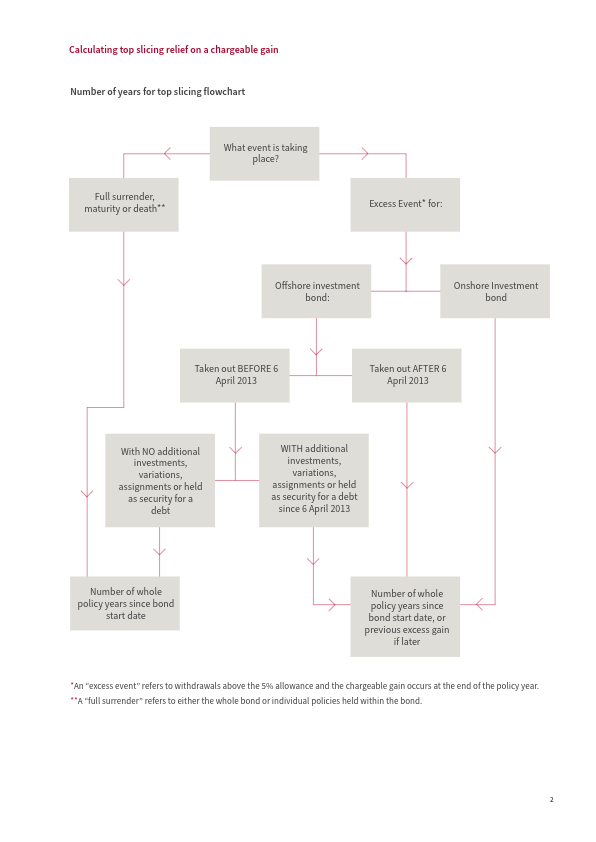
Working out how many full years to use in a top slicing calculation can be tricky, as it depends on whether the bond is onshore or offshore, the type of surrender, and when the bond was established.

If you’re surrendering the whole bond, or whole segments, you can use the number of full years since the bond was established.

If the gain has been caused by an excess event (taking a withdrawal above the 5% allowance from across all segments) and the bond is onshore, you use the number of full years since the last excess event. In this situation, but with an offshore bond, it gets a bit more complicated. Luckily, there are some handy flowcharts available online. I have used the one below from Canada Life as an example.

Flow Chart Calculating top slicing relief on a chargeable gain

This is just a quick roundup of some of the things to look out for when doing a bond surrender calculation. Are there any other tricky areas that might catch you out when doing a bond surrender?


One of the common misconceptions our paraplanners see is that attitude to risk trumps capacity for loss, when it’s more likely to be the other way around. While a client may have the appetite for risk, they may not have the financial ability to absorb any losses that result from a higher-risk investment.

As part of the recent thematic review of retirement income advice, the FCA wrote-

“ATR  is a subjective measurement of an individual’s willingness to accept risk while CFL relates to their ability to absorb losses. ATR and CFL are both key elements of risk profiling. When moving from accumulation to decumulation it is likely that the ATR and CFL for many customers will change so needs to be reassessed”

The FCA has reported that some firms are not assessing CFL for customers. Neglecting Capacity for Loss (CFL) in the decumulation phase can result in firms inaccurately pinpointing suitable income or investment-based solutions for their clients. This oversight may prompt customers to undertake excessive risk, potentially subjecting them to income reductions that exceed their ability to endure.

That’s why We Complement feels assessing capacity for loss is a vital part of many suitability reports and a concept that all paraplanners are familiar with. Read on to discover five important points you need to consider when assessing a client’s capacity for loss.

1. The Financial Conduct Authority (FCA) requires the capacity of loss to be considered

In March 2021, the FCA published its Finalised Guidance on Assessing Suitability. In it, the authority defined capacity for loss as the following:

”The customer’s ability to absorb falls in the value of their investment. If any loss of capital would have a materially detrimental effect on their standard of living, this should be taken into account in assessing the risk that they are able to take.”

The statement follows the FCA’s 2017 Guidance Consultation document, which requires Advisers to consider a client’s attitude to risk as part of assessing suitability. It goes on to add that:

“The client’s capacity for loss (the client’s ability to absorb falls in the value of their investment) should also be taken into account.”

2. Several factors influence your client’s capacity for loss

When considering your client’s capacity for loss, there are many aspects of their financial situation that need to be considered carefully. These include:

  • Income needs
  • Present and future income sources
  • Other assets
  • Expected inheritances
  • Time horizon before the investment will be drawn upon.

Once considered it’s vital to ensure that you make detailed notes in the fact-find.

3. There are two types of losses

Broadly speaking there are two types of loss advisers need to consider: permanent and temporary. The prospect of a client suffering a loss that they have no chance of recovering is different to a loss that they can expect to recover over time.

It’s important to assess this and understand whether the client could withstand one of these types of loss but not the other, both, or neither.

4. Understand the difference between the client’s willingness to accept risk (attitude to risk) and their ability to withstand it (capacity for loss).

While capacity for loss and attitude to risk are distinct from one another and should be assessed separately, it’s important to also consider them together. This will provide a balanced view of your client’s situation.

For example, if a client has a low capacity for loss but says they’re willing to take a high degree of risk, it’s likely that their capacity for loss will be the limiter on the solutions you recommend.

5. Cashflow modelling is a good way to determine capacity for loss

There is no single correct way to assess capacity for loss, and different advisers prefer different methods. Cashflow modelling is typically the most precise way of assessing capacity for loss, as you can calculate a loss in percentage terms and see how this interacts with your client’s cash flow forecast.

Capacity for loss questionnaires are also popular, or you could look at the client’s income requirements and how this could be affected by any loss made.

Get in touch

If you would like to discuss capacity for loss in more detail, or how we can ensure that your suitability reports stand up to scrutiny, please contact us online or call 01472 728 030.


Navigating Capacity for Loss: Key Insights for Savvy Paraplanners

One common misconception in the paraplanning world is the belief that attitude to risk takes precedence over capacity for loss, when, in reality, it’s often the other way around. Understanding a client’s financial ability to absorb losses is paramount, and here are five crucial points to consider when assessing capacity for loss:

1. FCA Mandate on Capacity for Loss
In March 2021, the Financial Conduct Authority (FCA) emphasised the importance of considering capacity for loss in suitability reports. The FCA defines it as the customer’s ability to absorb falls in the value of their investment, especially if it would materially impact their standard of living. This underscores the need for a thorough assessment beyond just attitude to risk.

2. Factors Influencing Capacity for Loss
Assessing capacity for loss requires a comprehensive look at various financial aspects:
– Income needs
– Present and future income sources
– Other assets
– Expected inheritances
– Time horizon before investment withdrawal

Documenting these details in the fact-find is essential for a holistic understanding.

3. Distinguishing Between Types of Losses
Paraplanners should differentiate between permanent and temporary losses. Understanding whether a client can recover from a loss over time is crucial. This nuanced evaluation ensures tailored recommendations based on the specific nature of potential losses.

4. Integration of Attitude to Risk and Capacity for Loss
While distinct, attitude to risk and capacity for loss should be assessed together. For instance, a client expressing a willingness to take high risks but having a low capacity for loss implies that the latter will dictate recommended solutions. This integrated approach provides a balanced view of the client’s financial landscape.

5. Precision with Cashflow Modelling
There’s no one-size-fits-all method for assessing capacity for loss, but cashflow modelling stands out for its precision. Calculating losses in percentage terms and aligning them with a client’s cashflow forecast provides a tangible understanding. Additionally, capacity for loss questionnaires and examining income requirements can offer valuable insights.

Tony’s thoughts

I see many examples of capacity for loss only given a cursory nod by advisers with the product selection and tax tail wagging the recommendations. If someone does not have three to six months of available cash to cover income or sufficient cash to cover known expenditure (holidays, car purchase, home improvements etc.) in the next 12 months then quite simply they should not be investing for five years plus! My other bug bear is the immediate use of pensions due to the tax relief available rather than a sensible use of say ISAs to provide a level of medium term cash needs, given that pension fund access could be decades away.

Top Tip: Prioritise Capacity for Loss
As Hannah suggests place capacity for loss as the primary decision-maker, superseding attitude to investment risk. This approach ensures a solid foundation for crafting well-informed and client-centric recommendations.

**Get in Touch**
If you want to delve deeper into capacity for loss discussions or ensure the robustness of your suitability reports, reach out to us at hello@wecomplement.co.uk or call 01472 728 030.

Navigate capacity for loss wisely, and let’s elevate the standard of financial planning together! 🚀💡 #Paraplanning #FinancialAdvice #CapacityForLoss #FCAGuidance #InvestmentRisk

ISO/IEC 27001:2022 certified
UKAS-accredited information security management system
You can verify the validity of our ISO certificate via the UKAS register.

ISO/IEC 27001:2022 certified

Affiliate of

Consumer Duty Alliance

Proud to work with

Paradigm ValidPath

Contact

Old Brewery Business Centre
Castle Eden
Co. Durham
TS27 4SU

Tel: +44 (0)1472 728 030
Email: hello@wecomplement.co.uk

© 2026 We Complement | Privacy Policy
We Complement Limited registered in England & Wales under company number 13689379, ICO number ZB427271. Registered address: Old Brewery Business Centre, Castle Eden, Co. Durham, TS27 4SU.

