Talk to us

Tax Relief Isn’t the Whole Story: AIM portfolios and the risk of sounding more familiar than they are

By
Claire Robertson

Tax-Efficient Investments

AIM portfolios can sometimes feel easier to explain than other tax-efficient investments.

They are shares.

There is a market.

There is a portfolio.

The client may already understand the idea of investing in companies, especially if they have pensions, ISAs, model portfolios or direct equity experience.

So compared with something like EIS, AIM can feel a little more familiar.

But that is exactly where advisers need to be careful.

Because familiar does not always mean simple.

And it definitely does not mean low risk.


Why AIM portfolios come up in advice conversations

AIM portfolios are often considered where a client has an inheritance tax planning objective but does not want to give money away.

That might be because they want to retain ownership.

They may be worried about future care costs.

They may not feel comfortable with outright gifts or trusts.

They may want something that feels more flexible than traditional estate planning.

For the right client, an AIM portfolio can have a place. Certain AIM shares may qualify for Business Relief, which can mean they fall outside the estate for inheritance tax purposes after two years, provided they are still held at death and continue to qualify.

That two-year point often gets attention.

It can sound much more appealing than the seven-year gifting rule.

But for advisers, the important bit is making sure the client understands what sits behind that headline.

Because this is still an investment-led strategy.

And the suitability work is not just about whether the client wants to reduce inheritance tax.

It is about whether they can accept the investment risk, liquidity risk and qualifying-status risk that come with this route.


The familiarity risk

One of the practical challenges with AIM is that clients may hear “shares” and assume they understand the risk.

They might mentally compare it with investments they already hold.

A pension portfolio.

An ISA.

A managed equity fund.

A mainstream UK equity allocation.

But AIM exposure can behave very differently.

The companies may be smaller. The market can be more volatile. Trading volumes can be lower. Share prices may move sharply. Selling may not always be straightforward, especially in stressed market conditions.

That does not make AIM unsuitable.

But it does mean the conversation needs to be specific.

Not just:

“The client understands investment risk.”

More like:

“The client understands the additional risks associated with smaller companies, AIM-listed shares, possible liquidity constraints and the fact that Business Relief is not guaranteed.”

That distinction matters.

A client who is comfortable with a mainstream balanced portfolio may not automatically be comfortable with a concentrated smaller-company portfolio used for IHT planning.

So a useful adviser question is:


Has the client understood how this could feel in practice, not just how it works on paper?

For example, would they still feel comfortable if the portfolio fell sharply? Would they still want to hold it if markets were unsettled? Would they be able to avoid making a rushed decision if the value moved against them?

Those questions can make the risk feel more real.


The two-year point needs careful framing

The two-year holding period is often the part clients remember.

But time alone is not the whole story.

For Business Relief to apply, the shares must remain qualifying and usually need to be held at death. If the underlying shares cease to qualify, or the rules change, the expected inheritance tax treatment may not apply in the way the client originally hoped.

That can be easily missed if the conversation becomes too focused on “two years”.

A practical way to frame it with clients is:


“The two-year point is not a finish line. It is one condition in a planning strategy that needs to continue working.”

That wording helps keep the conversation balanced.

It also makes clear that AIM is not a guaranteed tax shelter. It is an investment portfolio with potential IHT benefits attached.

For the advice file, it is worth evidencing that the client understands:

The shares need to remain qualifying.

The tax treatment can change.

The value of the portfolio can fall.

Access may not be immediate.

The investment may need to be held until death for the intended IHT outcome.

That last point is especially important.

Because if the client thinks of AIM as a short-term two-year solution, there may be a mismatch between what they believe they are doing and what the planning actually requires.


The rule change advisers need to factor in

There is also a newer planning point that needs to be part of the conversation.

From 6 April 2026, qualifying AIM shares are expected to receive 50% Business Relief for inheritance tax purposes, rather than the 100% relief that has historically applied. That means the IHT position may still be beneficial, but it is not the same planning outcome clients may have heard about before.

For advisers, this makes the suitability discussion even more important.

If the relief is lower, the investment case, risk profile, liquidity position and client understanding need to stand up even more clearly. The question is no longer just whether AIM could reduce an IHT liability, but whether the remaining tax benefit is enough to justify the additional risk for this client.

That is especially important for existing clients who already hold AIM portfolios. Their original recommendation may have been made under a different relief expectation, so review conversations may need to revisit whether the planning still feels proportionate.


The access conversation needs more than “you retain control”

AIM portfolios are often attractive because they allow the client to retain ownership and potential access.

That can be a real advantage compared with gifting.

But “retaining access” needs careful explanation.

There is a difference between:

“You still own the investment.”

and

“You can access the money quickly, at a stable value, whenever you need it.”

Those are not the same thing.

For advisers, this is where the conversation needs to connect back to the client’s real life.

Could they need the money for care?

Would they use it to support family?

Is this part of their emergency reserve?

Would selling during a market fall create a problem?

Could they meet income and capital needs without relying on this portfolio?

A useful sense-check is:


If the client needed this money sooner than expected, and the AIM portfolio was down at the time, would the wider plan still work?

If the answer is no, or not comfortably, the recommendation may need more thought.

That does not automatically rule AIM out.

But it does mean the advice needs to show how the access risk has been explored, rather than simply saying the client retains control.


What advisers may want to evidence

For advisers and paraplanners, a strong AIM case usually shows why this route fits the client’s wider circumstances, not just their IHT objective.

That might include evidencing:

Why the client is considering AIM now.

Why gifting, trusts, life cover or spending strategies were not preferred.

How much of the estate or portfolio is being allocated.

Whether the client can tolerate capital loss.

Whether the client can cope with delayed or uncertain access.

What investment experience the client already has.

How smaller-company risk has been explained.

Whether the client understands qualifying-status risk.

Whether the client understands this may need to be held until death for the intended IHT outcome.

Whether the recommendation remains proportionate.

That final point is worth pausing on.

AIM may be suitable for part of the client’s estate planning.

That does not mean it is suitable for too much of it.

Proportion matters.

Especially where the client is older, nervous about markets, reliant on the capital, or already carrying other investment risks elsewhere.


The practical takeaway

AIM portfolios can be useful.

But they should not be made to sound simpler than they are.

The key adviser challenge is making sure the client does not confuse familiarity with suitability.

Yes, AIM involves shares.

Yes, there may be a market.

Yes, there may be potential IHT benefits after two years.

But the client still needs to understand the investment risk, the liquidity risk, the qualifying-status risk and the fact that the tax outcome is not guaranteed.

A helpful question to come back to is:


Is the client choosing this because they understand the whole trade-off, or because the two-year IHT point sounds attractive?

That is often where the real advice work sits.

Last week, we looked at EIS and the risk of letting the reliefs become louder than the risks.

This week, AIM portfolios bring a slightly different challenge.

The risk is not always that the client does not understand investments at all.

Sometimes it is that the investment sounds more familiar than it really is.

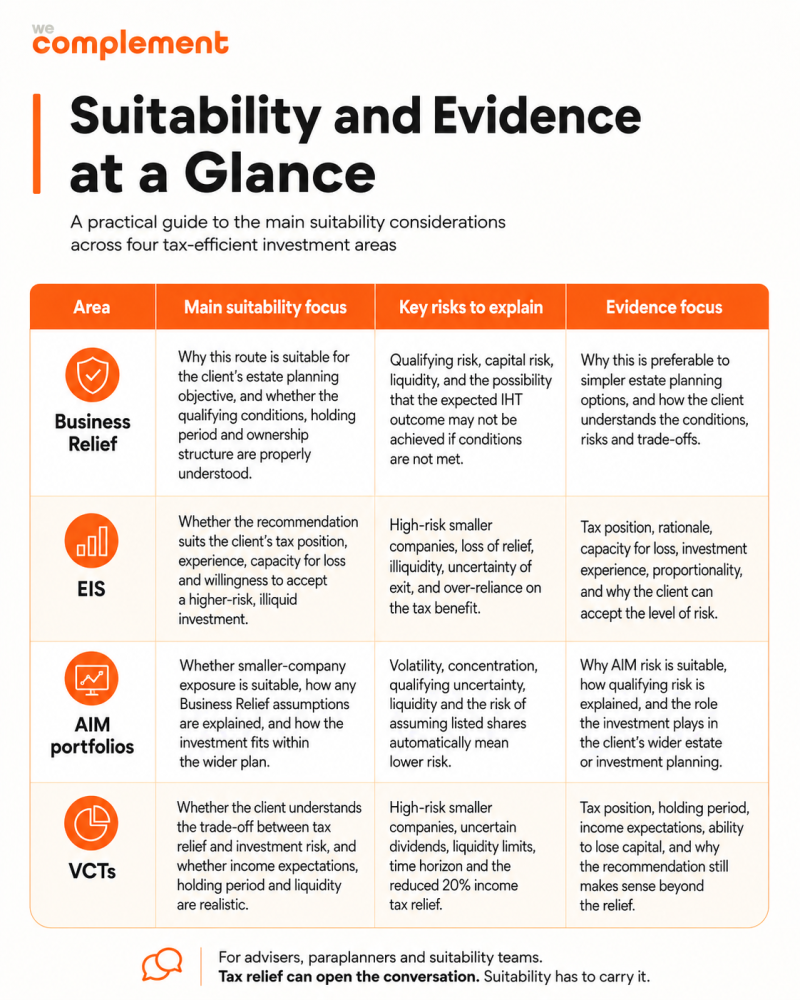
We’ll be sharing the full guide at the end of the series, covering Business Relief, AIM portfolios, VCTs and EIS.

For now, the point is simple.

Tax relief matters.

But suitability is what makes the recommendation stand up.

For anyone who wants to look at the background in more detail, HMRC has guidance on how Business Relief works for inheritance tax, including what may qualify and how relief is claimed.

Business Relief for Inheritance Tax

The London Stock Exchange also has a useful overview of AIM as a growth market.

AIM – Funding innovation for over 30 years

And for a wider reminder on risk communication, the FCA’s review of financial promotions for high-risk investments is worth keeping in mind, especially when thinking about how clearly clients understand the risks as well as the potential benefits.

Financial Promotions for high-risk investments

There is a point in some EIS conversations where things can start to move quite quickly.

The client hears 30% income tax relief.

Then capital gains tax deferral.

Then tax-free growth after three years.

Then loss relief.

Then possible inheritance tax relief after two years.

And before long, the conversation can start to feel less like an investment recommendation and more like a list of attractive tax features.

You can understand why EIS gets attention.

It offers some of the most generous tax reliefs available to UK investors. For the right client, in the right circumstances, it can have a place within a wider planning strategy.

But it is also one of those areas where advisers often have to work hardest to keep the conversation balanced.

Because with EIS, the tax relief is only part of the story.

The practical challenge is making sure the client understands what they are accepting to access those reliefs.


Why the client may focus on the reliefs first

Enterprise Investment Schemes are designed to encourage investment into smaller, early-stage companies.

Clients can invest directly into qualifying companies, or through a specialist manager who invests across a spread of qualifying businesses.

The tax position can be appealing.

There may be 30% income tax relief, as long as the client has enough income tax liability.

There may be an option to carry back the investment and treat it as if it was made in the previous tax year.

There may be capital gains tax deferral.

There may be tax-free growth if the shares are held for at least three years and the companies remain qualifying.

There may be loss relief if the investment falls in value.

And in some cases, shares may qualify for Business Relief if held for at least two years at death.

That is a lot for a client to take in.

And that is where the advice conversation can become tricky.

A client may understand each tax point when it is explained on its own. But that does not always mean they have understood the overall trade-off.

So one useful adviser question is:


Can the client explain back, in their own words, what they are investing in and what could go wrong?

Not just what reliefs they may receive.

What could go wrong.

That is often where the quality of understanding becomes clearer.


The risk needs as much airtime as the relief

EIS investments are not just tax-efficient.

They are high risk.

They usually involve early-stage or smaller companies. The businesses may be unlisted. The investment may be difficult to sell. Returns are uncertain. Capital is very much at risk.

There is also qualifying status risk. If a company stops meeting the EIS requirements, reliefs already granted may have to be repaid to HMRC.

That point is worth slowing down on.

Because this is not just:

“The investment could fall in value.”

It is also:

“The tax position depends on certain conditions continuing to be met.”

That is a different kind of risk, and it needs to be explained clearly.

For advisers, this is where generic risk wording is unlikely to be enough.

It is worth being specific about the type of risk the client is taking:

Early-stage company risk.

Illiquidity.

Uncertain exit.

Potential loss of tax relief.

A longer-term commitment.

A return profile that may look very different from a mainstream investment.

If the client has only ever held pensions, ISAs, model portfolios or mainstream funds, that difference needs to be brought to life.

A useful test is:


Have we explained the risk in a way that relates to this client’s actual experience, not just their attitude to risk score?

Because being comfortable with investment risk in a balanced portfolio is not the same as being comfortable with early-stage company risk.

The exit question needs to be asked early

One of the most useful questions in an EIS case is:


How does the client think they are going to get out?

It sounds simple, but it can open up a lot.

EIS is not usually something a client can sell quickly if they change their mind. Even where there is a planned exit strategy, it is not guaranteed. The timing, valuation and route to exit all depend on what happens with the underlying companies.

This is where the manager’s role becomes important.

What is the investment focus?

How are companies selected?

How diversified is the portfolio?

What does the manager expect the exit route to be?

What happens if exits take longer than expected?

The client does not need to become an EIS expert.

But they do need to understand enough to make an informed decision.

Especially where the recommendation is being discussed around a tax-year deadline, a CGT event, or a desire to reduce income tax.

Tax planning deadlines can create pressure.

The suitability conversation needs to slow that pressure down.

A practical sense-check here is:


Are we recommending this because the client has a suitable need, or because there is a tax deadline approaching?

Deadlines may explain urgency.

They should not create suitability.


What advisers may want to evidence

For advisers and paraplanners, EIS cases often need more than a technical explanation of the reliefs.

They need a clear trail showing why EIS is suitable for this particular client.

That might mean evidencing:

Why the client is considering EIS now.

What tax issue is being addressed.

Why alternative planning routes were not preferred.

How much of the client’s overall wealth is being allocated.

Whether they can afford to lose the capital invested.

Whether they can cope with a delayed or uncertain exit.

What investment experience they already have.

How the manager’s approach has been explained.

Whether the client understands the risk of losing qualifying status.

This does not need to make the advice file longer for the sake of it.

But it does need to make the reasoning clear.

Especially if the client has been drawn to the investment because the tax reliefs look attractive.

A helpful question to come back to is:


If the tax reliefs were less generous, would this still look like a sensible recommendation for this client?

The answer does not have to be yes in every case. Tax planning is a valid objective.

But if the whole recommendation relies on the reliefs doing the heavy lifting, it is worth pausing and testing the advice again.


The practical takeaway

EIS can be a valuable planning tool.

But it needs a clear suitability trail.

Not just:

“The client wants tax efficiency.”

Not just:

“The client is high risk.”

Not just:

“The client understands capital is at risk.”

The stronger cases are usually the ones where the adviser can show why this client, with this objective, this tax position, this experience, this capacity for loss and this wider portfolio, can justify taking on this type of investment.

That is the real work.

Not making EIS sound less risky than it is.

Not letting the tax reliefs carry the recommendation.

But helping the client understand the trade-off clearly enough to make a properly informed decision.

Last week, we looked at Business Relief and the access question.

This week, EIS reminds us of something slightly different.

Sometimes the hardest part of suitability is not explaining what the tax relief does.

It is making sure the relief does not become louder than the risk.

We’ll be sharing the full guide at the end of the series.

For now, the point is simple.

Tax relief matters.

But it should never be doing all the talking.

Business Relief often comes into the conversation when clients want two things that do not always sit easily together.

They want to reduce a potential inheritance tax liability.

But they also want to keep access to their money.

That is what makes BR interesting.

For the right client, it can offer a route into inheritance tax planning without making an outright gift, setting up more complex arrangements, or relying on the seven-year gifting rule.

The headline is usually easy enough to explain. Qualifying investments may benefit from inheritance tax relief after two years, provided they are still held at death.

That is the bit clients tend to remember.

Two years.

Potential IHT relief.

Capital still in their name.

But in practice, the suitability conversation is rarely that simple.

Because Business Relief is not just an inheritance tax planning tool. It is an investment. And that means risk, access, liquidity and understanding all need to be properly worked through.


What makes BR attractive?

BR can be useful where a client has a genuine IHT planning need, but gifting does not quite fit.

That might be because they are not comfortable giving money away.

They may want to retain control.

They may be concerned about future care needs.

They may want the option of accessing capital later.

Or they may simply feel that a seven-year planning horizon is too uncertain.

In those situations, BR can look like a helpful middle ground.

It can give the client a way to plan for IHT while keeping the investment in their own name. Some solutions may also allow access, although this can depend on the provider, the underlying assets and market conditions.

That flexibility is often where the appeal lies.

But it is also where the advice needs care.


The access point is not as simple as it sounds

One of the most important questions with BR is not just:

“Does the client want access?”

It is:

“What kind of access do they think they have?”

There is a big difference between money being technically accessible and money being quickly, easily or reliably accessible.

That is where misunderstandings can creep in.

A client might hear “you can still access your capital” and take comfort from that. But if the underlying investments are in smaller or unquoted businesses, selling may not be instant. Liquidity may be limited. The value may move. Access could take longer than expected.

That does not make BR unsuitable.

But it does mean the access conversation needs to be very clear.

In day-to-day advice work, this is the bit I think needs more attention.

Not just whether the client says they are happy with the risk, but whether they understand what that risk might feel like later.

Especially if circumstances change.

A client who does not expect to need the money today may feel very differently if care costs arise, family circumstances shift, or they simply become less comfortable with investment risk as they get older.


When the tax benefit starts leading the conversation

There is another point worth pausing on.

Business Relief can be attractive because the tax benefit is clear and easy to quantify. That can make it tempting for the tax outcome to become the main focus of the recommendation.

But tax efficiency on its own is not suitability.

The file still needs to show why this solution fits the client’s wider position.

That includes their objectives, their attitude to risk, their capacity for loss, their need for access, their understanding of the investment and the alternatives considered.

A useful sense-check is:

If the IHT relief was removed from the conversation, would there still be a coherent reason for this client to hold this type of investment?

The answer does not always need to be yes. IHT planning can be a valid objective in its own right.

But if the whole recommendation only makes sense because of the relief, the advice probably needs more careful framing.

At the very least, the client needs to understand exactly what they are accepting in exchange for that potential tax benefit.


What advisers and paraplanners need to evidence

For advisers and paraplanners, BR cases are often less about explaining the rules and more about evidencing the trade-off.

That means being able to show:

The client has a clear IHT planning objective.

Gifting, trusts or other planning options have been considered.

The need for access has been explored properly.

The client understands that access may not be immediate.

The investment risk is suitable for their circumstances.

The client understands capital is at risk.

The recommendation is not being driven by tax relief alone.

None of this needs to be overcomplicated.

But it does need to be clear.

Because if a case is ever reviewed later, the question will not just be whether BR was technically available.

It will be whether the recommendation was suitable for that client at that time, based on what they needed, what they understood and what they could afford to risk.


The practical takeaway

The strongest BR conversations are often the ones where the benefits and limitations are given equal weight.

Not in a way that scares the client off.

Just in a way that keeps the advice balanced.

BR can be a valuable planning option. But it should not be presented as a neat fix for inheritance tax.

It is better understood as a trade-off.

Potential IHT relief.

Retained control.

Some access.

But with investment risk, possible liquidity constraints and a need for proper client understanding.

That is where the real advice work sits.

Not in knowing that the two-year rule exists, but in making sure the client understands what sits behind it.

Over the next few weeks, I’ll be looking at BR, AIM portfolios, VCTs and EIS as part of our Tax Relief Isn’t the Whole Story series.

We’ll be sharing the full guide at the end, but for now the main point is this:

Tax relief matters.

But suitability is where the real work starts.


ISO/IEC 27001:2022 certified
UKAS-accredited information security management system
You can verify the validity of our ISO certificate via the UKAS register.

ISO/IEC 27001:2022 certified

Affiliate of

Consumer Duty Alliance

Proud to work with

Paradigm ValidPath

Contact

Old Brewery Business Centre
Castle Eden
Co. Durham
TS27 4SU

Tel: +44 (0)1472 728 030
Email: hello@wecomplement.co.uk

© 2026 We Complement | Privacy Policy
We Complement Limited registered in England & Wales under company number 13689379, ICO number ZB427271. Registered address: Old Brewery Business Centre, Castle Eden, Co. Durham, TS27 4SU.