
Talk to us

Navigating Bond Surrender Calculations: Tips & Traps

By
Hannah Keane

Investments

I’ve completed dozens of bond surrender cases this year, and encountered several recurring themes and common pitfalls when dealing with bond surrender calculations. These calculations can be fiddly, especially if you haven’t dealt with one for a while. Dealing with changing regulation on certain aspects (I’m looking at you, top slicing relief) can make it easy to overlook or forget certain aspects. I hope this blog is a helpful memory jog on the more finicky aspects of bond surrenders.

Unintended Consequences

  • Student loan repayments: Remember that bond gains are taxable income, so even if there’s no tax due on the gain, a bond surrender could lead to the recipient having to repay more of their student loan. Depending on their circumstances, this might be taken from their salary via PAYE.
  • Tapered personal allowances: Similar to the above point, there might be no tax to pay on a gain, but the gain might increase the client’s annual income to a level that they lose an element of their personal allowance.
  • Care costs: As long as the investment isn’t treated as a deliberate deprivation of assets, bonds are often ignored by a Local Authority when a client is being means-tested for care funding. This is something to be aware of if an older client who has held a bond for a long time is considering surrendering it and holding it as cash, for example.

Bonds in Trusts

Normally, a bond gain falls on the policyholder and becomes part of their income for tax purposes. This is similar for absolute trusts, where the gain falls on the beneficiary.

For bonds held in other types of trust, the rules are a little different:

  • If the settlor is a UK resident and alive in the tax year of the gain, the gain falls on them. The settlor can reclaim any tax they pay from the trustees.
  • If this isn’t true of the settlor, the gain falls on any UK resident trustees. Note that the old £1,000 standard rate band has been removed, so all gains that fall on the trustees are taxed at the trustee rate of 45%. If the trust only receives income below the allowable tax-free amount (usually £500), then the trust doesn’t have to pay income tax. If the trust receives more income than the tax-free amount, tax is due on the whole amount of income.
  • If there are no UK resident trustees, the gain falls on the UK beneficiaries.

The Timing of Bond Gains

This is a small but easily overlooked point: the two types of bond gains are taxed at different times.

Surrendering whole segments will result in taxpayers having to pay any tax on the gain in the tax year the surrender was made.

On the other hand, if you make a withdrawal across all segments, the tax on the gain will be payable in the tax year that the policy year ends in. For example, take a withdrawal made via this method on 1st April 2024, where the policy year ends on 1st September 2025. The withdrawal takes places in the 2023/24 tax year, but the gain will be taxed in the tax year that 1st September 2025 falls into, i.e. the 2024/25 tax year.

Order of Tax

Onshore and offshore bond gains are savings income, and they can both potentially make use of the Personal Savings Allowance and Starting Rate for Savings. However, they’re not treated identically for tax purposes.

Onshore bonds are treated as the top part of income, and are taxed last, after non-savings income, other savings income and dividends. Offshore bonds slot in with other savings income, so are taxed before dividends and after non-savings income.

Top Slicing

Interaction with Personal Allowance, Personal Savings Allowance and Starting Rate for Savings

There have been some recent changes to these rules which can catch you out if you don’t deal with bond surrenders regularly.

In mid-2023, HMRC updated their guidance on how the above three allowances interact with top slicing relief. Prior to this updated guidance, when calculating the tax due on the average gain for top slicing purposes (step 4 of the calculation), you used the client’s income plus the full gain to determine whether the PSA and SRFS were available. On the other hand, eligibility for the Personal Allowance was based on the sliced gain, so you could potentially reinstate the Personal Allowance.

After the updated guidance, for step 4 of the calculation, the amount of PSA, SRFS and PA the client is eligible for is based on the sliced gain, not the full gain.

It’s important to note that this is only applicable to step 4 of the calculation, and not the calculation as a whole. Nevertheless, this could still result in some clients paying less tax.

Eligibility

Only individuals can claim top slicing relief. As bonds in absolute trusts are typically taxed, as though the beneficiary owns the bond, beneficiaries of absolute trusts can also claim top slicing relief.

For other types of trusts, if the trust assigns segments to a beneficiary, that beneficiary can claim top slicing relief going back to when the bond was established. Trustees cannot claim top slicing relief. Settlors can claim top slicing relief.

Top Slicing Years

Working out how many full years to use in a top slicing calculation can be tricky, as it depends on whether the bond is onshore or offshore, the type of surrender, and when the bond was established.

If you’re surrendering the whole bond, or whole segments, you can use the number of full years since the bond was established.

If the gain has been caused by an excess event (taking a withdrawal above the 5% allowance from across all segments) and the bond is onshore, you use the number of full years since the last excess event. In this situation, but with an offshore bond, it gets a bit more complicated. Luckily, there are some handy flowcharts available online. I have used the one below from Canada Life as an example.
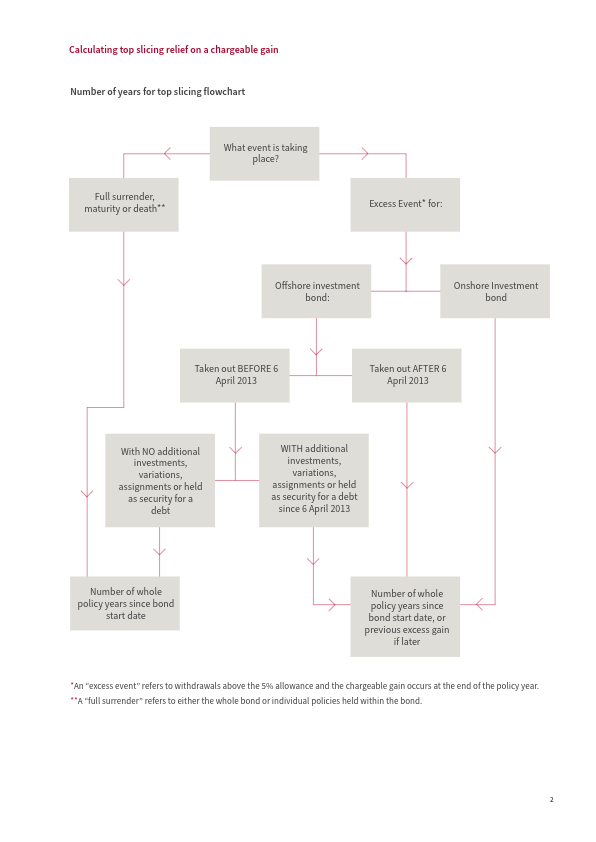
Flow Chart Calculating top slicing relief on a chargeable gain

This is just a quick roundup of some of the things to look out for when doing a bond surrender calculation. Are there any other tricky areas that might catch you out when doing a bond surrender?
 

One of the common misconceptions our paraplanners see is that attitude to risk trumps capacity for loss, when it’s more likely to be the other way around. While a client may have the appetite for risk, they may not have the financial ability to absorb any losses that result from a higher-risk investment.

As part of the recent thematic review of retirement income advice, the FCA wrote-

“ATR  is a subjective measurement of an individual’s willingness to accept risk while CFL relates to their ability to absorb losses. ATR and CFL are both key elements of risk profiling. When moving from accumulation to decumulation it is likely that the ATR and CFL for many customers will change so needs to be reassessed”

The FCA has reported that some firms are not assessing CFL for customers. Neglecting Capacity for Loss (CFL) in the decumulation phase can result in firms inaccurately pinpointing suitable income or investment-based solutions for their clients. This oversight may prompt customers to undertake excessive risk, potentially subjecting them to income reductions that exceed their ability to endure.

That’s why We Complement feels assessing capacity for loss is a vital part of many suitability reports and a concept that all paraplanners are familiar with. Read on to discover five important points you need to consider when assessing a client’s capacity for loss.

1. The Financial Conduct Authority (FCA) requires the capacity of loss to be considered

In March 2021, the FCA published its Finalised Guidance on Assessing Suitability. In it, the authority defined capacity for loss as the following:

”The customer’s ability to absorb falls in the value of their investment. If any loss of capital would have a materially detrimental effect on their standard of living, this should be taken into account in assessing the risk that they are able to take.”

The statement follows the FCA’s 2017 Guidance Consultation document, which requires Advisers to consider a client’s attitude to risk as part of assessing suitability. It goes on to add that:

“The client’s capacity for loss (the client’s ability to absorb falls in the value of their investment) should also be taken into account.”

2. Several factors influence your client’s capacity for loss

When considering your client’s capacity for loss, there are many aspects of their financial situation that need to be considered carefully. These include:

  • Income needs
  • Present and future income sources
  • Other assets
  • Expected inheritances
  • Time horizon before the investment will be drawn upon.

Once considered it’s vital to ensure that you make detailed notes in the fact-find.

3. There are two types of losses

Broadly speaking there are two types of loss advisers need to consider: permanent and temporary. The prospect of a client suffering a loss that they have no chance of recovering is different to a loss that they can expect to recover over time.

It’s important to assess this and understand whether the client could withstand one of these types of loss but not the other, both, or neither.

4. Understand the difference between the client’s willingness to accept risk (attitude to risk) and their ability to withstand it (capacity for loss).

While capacity for loss and attitude to risk are distinct from one another and should be assessed separately, it’s important to also consider them together. This will provide a balanced view of your client’s situation.

For example, if a client has a low capacity for loss but says they’re willing to take a high degree of risk, it’s likely that their capacity for loss will be the limiter on the solutions you recommend.

5. Cashflow modelling is a good way to determine capacity for loss

There is no single correct way to assess capacity for loss, and different advisers prefer different methods. Cashflow modelling is typically the most precise way of assessing capacity for loss, as you can calculate a loss in percentage terms and see how this interacts with your client’s cash flow forecast.

Capacity for loss questionnaires are also popular, or you could look at the client’s income requirements and how this could be affected by any loss made.

We have also looked more closely at capacity for loss vs attitude to risk, including how firms can evidence the difference clearly in a suitability report.

Get in touch

If you would like to discuss capacity for loss in more detail, or how we can ensure that your suitability reports stand up to scrutiny, please contact us online or call 01472 728 030.


Navigating Capacity for Loss: Key Insights for Savvy Paraplanners

One common misconception in the paraplanning world is the belief that attitude to risk takes precedence over capacity for loss, when, in reality, it’s often the other way around. Understanding a client’s financial ability to absorb losses is paramount, and here are five crucial points to consider when assessing capacity for loss:

1. FCA Mandate on Capacity for Loss
In March 2021, the Financial Conduct Authority (FCA) emphasised the importance of considering capacity for loss in suitability reports. The FCA defines it as the customer’s ability to absorb falls in the value of their investment, especially if it would materially impact their standard of living. This underscores the need for a thorough assessment beyond just attitude to risk.

2. Factors Influencing Capacity for Loss
Assessing capacity for loss requires a comprehensive look at various financial aspects:
– Income needs
– Present and future income sources
– Other assets
– Expected inheritances
– Time horizon before investment withdrawal

Documenting these details in the fact-find is essential for a holistic understanding.

3. Distinguishing Between Types of Losses
Paraplanners should differentiate between permanent and temporary losses. Understanding whether a client can recover from a loss over time is crucial. This nuanced evaluation ensures tailored recommendations based on the specific nature of potential losses.

4. Integration of Attitude to Risk and Capacity for Loss
While distinct, attitude to risk and capacity for loss should be assessed together. For instance, a client expressing a willingness to take high risks but having a low capacity for loss implies that the latter will dictate recommended solutions. This integrated approach provides a balanced view of the client’s financial landscape.

5. Precision with Cashflow Modelling
There’s no one-size-fits-all method for assessing capacity for loss, but cashflow modelling stands out for its precision. Calculating losses in percentage terms and aligning them with a client’s cashflow forecast provides a tangible understanding. Additionally, capacity for loss questionnaires and examining income requirements can offer valuable insights.

Tony’s thoughts

I see many examples of capacity for loss only given a cursory nod by advisers with the product selection and tax tail wagging the recommendations. If someone does not have three to six months of available cash to cover income or sufficient cash to cover known expenditure (holidays, car purchase, home improvements etc.) in the next 12 months then quite simply they should not be investing for five years plus! My other bug bear is the immediate use of pensions due to the tax relief available rather than a sensible use of say ISAs to provide a level of medium term cash needs, given that pension fund access could be decades away.

Top Tip: Prioritise Capacity for Loss
As Hannah suggests place capacity for loss as the primary decision-maker, superseding attitude to investment risk. This approach ensures a solid foundation for crafting well-informed and client-centric recommendations.

**Get in Touch**
If you want to delve deeper into capacity for loss discussions or ensure the robustness of your suitability reports, reach out to us at hello@wecomplement.co.uk or call 01472 728 030.

Navigate capacity for loss wisely, and let’s elevate the standard of financial planning together! 🚀💡 #Paraplanning #FinancialAdvice #CapacityForLoss #FCAGuidance #InvestmentRisk

ISO/IEC 27001:2022 certified
UKAS-accredited information security management system
You can verify the validity of our ISO certificate via the UKAS register.

ISO/IEC 27001:2022 certified

Affiliate of

Consumer Duty Alliance

Proud to work with

Paradigm ValidPath

Contact

Old Brewery Business Centre
Castle Eden
Co. Durham
TS27 4SU

Tel: +44 (0)1472 728 030
Email: hello@wecomplement.co.uk

© 2026 We Complement | Privacy Policy
We Complement Limited registered in England & Wales under company number 13689379, ICO number ZB427271. Registered address: Old Brewery Business Centre, Castle Eden, Co. Durham, TS27 4SU.

